Large-Scale Sound Registration System: Sonic Research in Plutonica

Drawing on alchemical texts, the work of philosophers such as Reza Negarestani, Nick Land, Timothy Morton and scientific theories from physics, geology, and astronomy, I developed Plutonica.
Plutonica is the science of plutonic processes, that is, of everything that originates from the depths, operates in concealment, and exceeds human scales of space and time. The name refers simultaneously to plutonism, the geological theory that igneous rocks were formed through intrusive magmatic activity, to Pluto, the god of the underworld, and to plutonium, the element that symbolizes radioactivity and the deep time of the technosphere.

THE BLACK OCEAN
Φ
𒍪𒀊
One of the fundamental premises of Plutonica is the Theory of the Black Ocean. It proposes that beneath the crust of the world accessible to human knowledge lies an immense, dynamic, and almost unknowable domain of matter. The inspiration for this theory is the planet’s interior, specifically the Earth’s liquid core. It is an infernal region composed primarily of iron, existing in a state of perpetual catastrophic collision. Within the imaginary framework of Plutonica, the Earth's core appears as the Black Ocean: a vast expanse of semi-fluid matter in constant motion. It is not merely a geological structure but the ontological foundation of reality itself. All surface processes: life, civilization, and culture float upon it like a thin layer of sediment. The Black Ocean carries a negative significance in relation to us; it is non-existence, an abstract force that moves things. It is a radically inhuman “world-without-us” existing in complete darkness. The matter of the Ocean is eternally active and irreducible to human categories. It circulates in a powerful metallic vortex that moves dangerously upward. The exact origin of the Ocean remains unknown. However, it can be stated with certainty that it is something entirely alien and external, living within the Earth since the very beginning of the Universe. From the perspective of Plutonica, ecological disasters, radioactive leaks, volcanic eruptions, and contaminated landscapes are moments when the Black Ocean becomes partially visible. They are ruptures in the surface order of the world through which deeply concealed processes reveal themselves. If the Black Ocean were to emerge completely onto the surface, the total annihilation of time and space would occur.
* The symbol that I have adopted as a provisional notation for the Black Ocean, shown above, is a cuneiform sign used in ancient Mesopotamia. It signifies Abzu (Sumerian abzu, Akkadian apsû), the primordial underground waters. In Mesopotamian cosmology, these waters were imagined as a vast reservoir or domain located beneath the surface of the Earth. Abzu is not simply an underground space, but a hidden reservoir of primordial matter, knowledge, and generative potential. It also symbolizes secret knowledge. Above the word Abzu appears the Greek letter phi (Φ). In physics, φ often denotes flux (for example, magnetic flux). In philosophy, phi is sometimes used as a symbol of nature, life, the soul, or an organizing principle. In my interpretation, it signifies the driving force of terrestrial transmutation.
THE IRON ISLAND
“Islands are from prehuman times or for times after humanity.”
“The island itself is the source - radical and absolute.”
— G. Deleuze
The geodynamo is the process through which the movement of liquid metal in the outer core generates a global magnetic field. Inside the Planet there is a highly conductive liquid core surrounded by an almost electrically insulating solid mantle, while the remaining part is a vacuum (called the Darkness Zone in Plutonica).
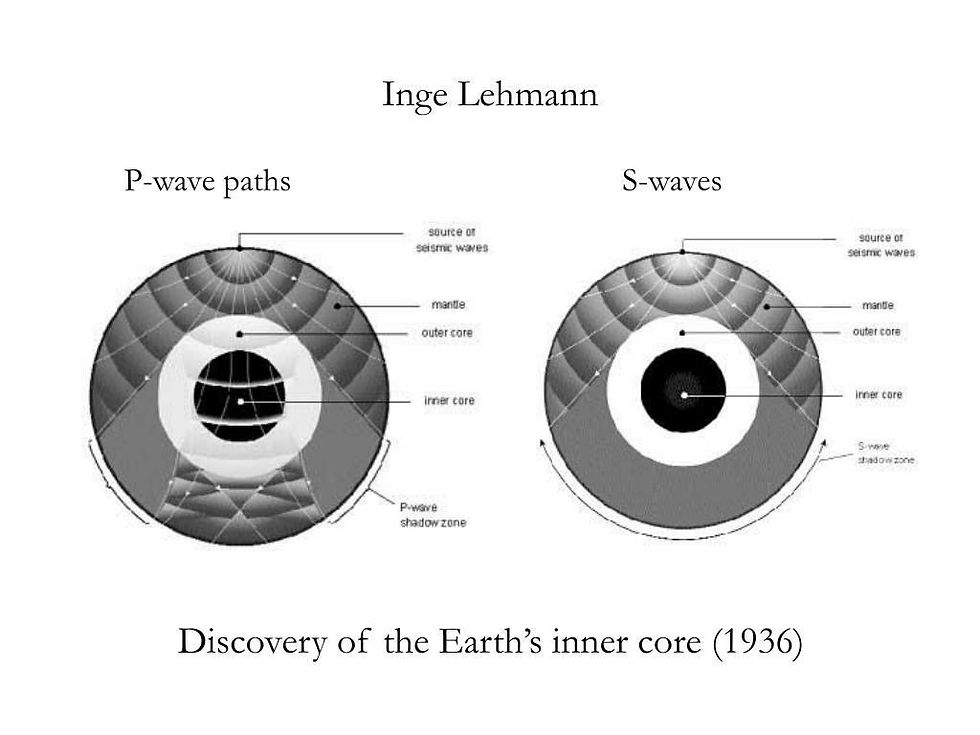
Exactly at the center, deep within the core of the Ocean, there is an island born of iron. It is formed from the solidified metal of the Ocean- the heart (or brain???) of the Planet. The island gradually grows, as increasing amounts of metal solidify along its shores. Iron is a very good electrical conductor. Electric current generates a magnetic field. Every change in the tides of the Black Ocean causes a change in the field. Such a change takes thousands of years. The electromagnetic “shell” insulating the rotating substance originates precisely from the Iron Island.
Each of the ontological layers of Plutonics is associated with a distinct field, developing its own theories. My aim is to organize the entire reality of the Black Ocean and articulate its underlying mechanics.
KATABATIC GEOLOGY
“Dead matter will transform into a black serpent.”
“The serpent bears the weight of the Earth upon itself, but also that which changes within it and which is the seed from which everything that comes into being becomes what it is.”
- The Red Book, C. G. Jung
The term Katabatic Geology derives from the Greek katabasis, meaning “descent” or “journey into the underworld.” In ancient mythologies, katabasis referred to a descent into the realm of the dead. Within Plutonica, it becomes a method for investigating the planet’s interior. Katabatic geology studies the trajectories through which dead matter, technological remains, and entire civilizations descend into archaeological and geological strata. It examines processes of burial, sedimentation, abandonment, and the gradual incorporation of cultural artifacts into the material history of the Earth. The discipline also encompasses the study of the crypticbiosphere and arche-fossils. Research on the deep biosphere helps answer questions about what the earliest forms of life on Earth may have been like and whether similar organisms could exist on other planets. Interestingly, organisms living in the cryptobiosphere do not require sunlight. One such place that I am currently working on is the Rio Tinto river in the province of Huelva, Andalusia (ES), which may be a remnant of the Archaic World of Iron. Its iron-controlled ecosystem is a complex system of an ancient, subterranean internal force. The river itself maintains a constant acidity of ~2.9 pH, contains extremely high concentrations of heavy metals, and, interestingly, supports a high level of microbial diversity. The acidity and toxicity of the Rio Tinto do not originate from mining runoff or waste, nor from extractive activity in the area (despite the fact that mining has been taking place there for 5,000 years). There is a hypothesis that a continuous subterranean reactor exists beneath the river, in which sulfide minerals serve as the primary energy source, while the river functions as an exhaust conduit, releasing the products of metabolism.

INFERNAL GEOCHRONOLOGY
“The impure part of the element of earth lies within the globe. The Earth is the repository of all treasures. At its center burns the infernal fire that holds together the entire structure of the world.”
- M. Sędziwój, Treatise on the Philosopher’s Stone
Infernal Geochronology investigates the history of the Earth from the perspective of extractive and mining processes. Rather than focusing on the chronology of civilizations, it examines the temporal history of excavation, resource exploitation, contamination, and the material transformations generated by human intervention in the planet's subsurface. It seeks to reconstruct the deep temporal entanglement between geological matter and extractive activity. Inferno is a place where all boundaries collapse and matter mixes together. Like something possessed, it assumes entirely new, hybrid forms. Inferno is a geological horror, this is where pools of dense oceanic fluid, leaked from within, begin to form.

The photographs show toxic sludge in Geamăna, located in a mining region of Romania rich in gold, silver, and copper. It is one of the oldest mining areas in Europe. Around 9 million years ago, an active magmatic system operated in the Apuseni Mountains. The Fundoaia intrusion is its “frozen” fragment, which came to rest several kilometers beneath the surface. Its hot fluids helped concentrate copper within the surrounding rocks.
In 1977, Nicolae Ceaușescu ordered the evacuation of the village of Geamăna, located near the Roșia Poieni Mine copper, now one of the largest open-pit mines in Europe. The village was flooded with toxic mining waste containing mercury, lead, and arsenic. The artificial lake created there originally covered 130 hectares and continues to grow today, changing the surrounding landscape. It became a strange and dangerous place, creating both fear and guilt. Toxic Geamăna is also a product of a deep magmatic system.

RESEARCH INTO TELLURIC SIGNALS
This is the most important part of Plutonica. The term telluric derives from the Latin Tellus, meaning Earth. In scientific contexts, it refers to phenomena such as telluric currents, natural electromagnetic fields, and geophysical processes occurring within the Earth's crust. Within Plutonica, however, the concept is expanded beyond its conventional meaning. It assumes that the Earth is not a passive geological object but a dynamic system continuously emitting signals from different layers of its structure. According to Plutonica, telluric signals influence all terrestrial organisms. These signals may take the form of seismic vibrations, electromagnetic fluctuations, radioactive emissions, mineral transformations, or other manifestations of subterranean activity. The task of telluric signal research is to detect, record, and interpret these transmissions as expressions of the Earth's ongoing processes and agencies. The most important and powerful transmitter of signals is the Iron Island. Everything that reaches us originates on the island; unfortunately, the signal collides with successive layers of the Planet’s structure, becoming split and deformed. It is possible that this is a kind of noise reflected from the island, the aftereffect of radiation from the very beginning of the Universe. So-called parasite noise, the same kind that once produced the “optical noise” seen on cathode-ray-tube televisions. Its trace was first identified in 1964 by two radio astronomers, Arno Penzias and Robert Wilson, who were working at Bell Telephone Laboratories in Holmdel, New Jersey. They were using an extraordinarily sensitive horn antenna originally built for experiments in satellite communications. They discovered that they had detected the Cosmic Microwave Background (CMB), a faint signal permeating the entire Universe, a remnant of its hot, dense state approximately 13.8 billion years ago. It is a signal originating entirely beyond the human timescale, reaching us from every direction in space.

LARGE-SCALE OBJECT SOUND REGISTRATION SYSTEM
I call the method of interpreting telluric signals seismoscryption. It derives from a field of study known as informatology. We are dealing with information embedded deep within geological processes. The task of Plutonics is to decrypt it. The technique involves the rigorous practice of decoding numerical data, such as concentrations of heavy metals in soil and water. The project I am currently developing, The Large-Scale Object Sound Registration System, is one of the cryptoscientific techniques within this framework. The technique emerged from my studies of Infernal Geochronology and focuses primarily on sites located around mines. I record individual sonic elements of contaminated landscapes in various forms, places where the Black Ocean may have potentially leaked by using a shotgun microphone, a geophone, and a hydrophone.

Depending on the location, I collect various types of environmental data, such as radiation levels, concentrations of heavy metals in water and soil, and the presence of cryptobiotic microorganisms. I then convert the resulting values into sound frequencies (Hz), from which specific musical notes are generated.
Examples for Geamăna:

The resulting frequencies are then composed using the instrument Moog Theremini, which works as a seismocryptographer. Because of its ghostly and omnipresent nature, sound has become for me the best tool for engaging with these phenomena. Sound connects with matter and technology and can enter deep time and its complex relationships. Sound itself is a spectrum. Sound recording has always been connected to the “invisible” and the “supernatural.” The first sound recording devices - the phonograph - was used by spiritualists who believed they could communicate with the dead. This belief was strengthened by the first law of thermodynamics, the principle of conservation of energy, which supported the idea that sounds never completely disappear but continue existing beyond the limits of human hearing. The fundamental physics of acoustics assumes the existence of a sound source, for example vocal cords or a subwoofer, which produces sound waves that then propagate through the air. Such waves physically affect us, brushing against us and passing through us; some are registered by our ears, but sometimes also by the chest cavity or breathing.
Lately, I have been trying to isolate telluric signals in my work, categorizing them by origin, type, and the depth from which they emerge. For now, these include the former Kowary uranium mine in Poland, the Romanian village of Geamana, flooded by a toxic lake, and the Rio Tinto river in Spain: a natural ecosystem governed by iron.

I call the compositions created on the theremini plasmatic music. Plasma matter is a highly plastic, dynamic form of matter capable of generating complex and continuously evolving structures. It is characterized by an ongoing capacity for transformation, epistemic elusiveness, high levels of activity, and material complexity. The theremin itself produces an otherworldly, non-human sound, generated through the interference of electromagnetic fields.

This is the first research method I have developed, and I continue to develop it as a way of bringing me closer to the interior of the Black Ocean. The signals I read as numerical data from elements and organisms are transformed back into electromagnetic waves, allowing me to hear them.

References:
Bonnet F.J., The Order of Sounds. A Sonorous Archipelago, Urbanomic, UK, 2016
CCRU, Abstract Culture: Digital Hyperstition, Katasonix, 1999
Dark Scenes from Damaged Earth. The Gothic Anthropocene., Edited by J.D.
Edwards, R. Graulund, J. Höglund, University of Minnesota Press, 2022
Leiber F., Black Gondolier: & Other Stories, Open Road Media, 2014
Leper Creativity: Cyclonopedia Symposium, Edited by Keller E., Masciandaro N., Thacker E., punctum books, Brooklyn Ny, 2012
Morton T., Hyperobjects. Philosophy and Ecology after the End of the World,
University of Minnesota Press, 2013
Negarestani R., Cyclonopedia: Complicity with Anonymous Materials, re.press
2008
Parrika J., A Geology of Media, University of Minnesota Press, 2017
Thacker E., In the Dust of this Planet: Horror of Philosophy vol.1, Zero Books,
Winchester and Washington, 2011
Unsound:Undead, Edited by Goodman S., Heys T., Ikoniadou E., Urbanomic, UK, 2019
Woodard B., On an Ungrounded Earth: Towards a New Geophilosophy, punctum books, Brooklyn NY, 2013


Comments