The Politics of Compression
- graysonearle
- Aug 5
- 3 min read
Generative models operate through extreme information compression, meaning they enforce what Matteo Pasquinelli identifies as a dictatorship of the past over the present. When confronted with an anomaly, the system cannot leave it unresolved. It forces the anomaly into pre-existing historical categories, actively restricting the possibility of a new historical event. Because the entire optimization objective is predicated on curve-fitting to a historical average, there is no reward signal for the unprecedented. The system is structurally designed to suppress deviation in favor of maintaining the existing order, guaranteeing that newness cannot enter.
A measured run of modelbending deliberately perturbs the weights of a diffusion model to subvert this imposed coherence. The model keeps every one of its parts and loses the ability to point them anywhere. This test executes twenty passes with one prompt held fixed, pushing the network off its historical curve.
Disintegration instrument log
Each pass selects a random 1% of the U-Net's values and nudges each selected one by a random amount up to 5% of that tensor's own range. Nothing is removed, and nothing is switched off. The same prompt is rendered again from the same seed, meaning every difference seen downstream comes from the weights and nothing else.
def modelbend(module, ratio, max_percent, generator=None):
    for _, param in module.named_parameters():
        t_range = (param.max() - param.min()).item()
        delta   = max_percent * t_range
        mask    = torch.rand(param.shape, generator=generator) < ratio
        shifts  = draw_shifts(delta)
        param[mask] += shifts[mask]
Three words do three different jobs here. The act is modelbending, which involves perturbing a trained network's weights so it produces what it was not built for. It compounds like databending, which itself takes after circuit bending. The effect is model disorientation, naming the resulting state. The model still runs completely, but the values no longer encode which direction leads toward a coherent image. Nothing is missing; nothing points anywhere. The frame is disintegration, naming what the viewer undergoes across the sequence. It is kept for the aesthetic register, never for the technique itself.
The decay family of words implies loss of integrity. A decaying object wears away and becomes less than it was. Here, the parameter count never changes and the magnitudes stay comparable. What is destroyed is alignment. Any term on the loss axis files this intervention next to the hallucination it is meant to be distinguished from. A hallucination is the system over-performing its function to force coherence, whereas model disorientation prevents the system from locating coherence at all.
The dose and the arithmetic
Two arithmetic facts govern how this accumulates. First, coverage compounds. A ratio of 1% does not mean 1% of the model. Each pass draws a fresh mask, making the fraction touched at least once reach 18.2% by pass twenty, not 1%. Second, drift is a random walk. Each pass adds a fresh zero-mean shift that partly cancels what came before, making displacement grow with the square root of N, not N. Doubling the passes buys 1.41 times the drift. The run bears this out exactly, as relative drift went from 12.78% to 18.07% between passes one and two.
The compass and the heading
At every denoising step the U-Net takes the current noisy latent and returns a prediction of the noise present. The sampler subtracts some of it. That prediction is a vector in the same space as the latent, meaning the junk is one way and it must move the other way. The model's output literally is a direction, and denoising is repeated movement along it.
The angle between the bent model's prediction and the pristine model's on identical inputs is a measurable quantity, called the disorientation angle. Zero means the bent model points exactly where the intact one does. Ninety degrees means its direction carries no information at all about the correct one. Because two random vectors in high dimensions are almost exactly orthogonal, 90 degrees is the noise floor rather than the midpoint of the scale.
Before measuring, the working assumption was that weight-space metrics would saturate uselessly near 1.0 while the disorientation angle swung across a wide range. The opposite happened. The weights rotate substantially, while the denoising direction turns only 10.35 degrees. The network absorbs an enormous amount of weight displacement into a small change of heading.
If the heading only shifts by a few degrees, the output becomes unrecognizable because the angle is a per-step error. The sampler compounds it across twenty-five sequential denoising steps, each one starting from where the last one landed. This is dead reckoning. A few degrees off, held for a long enough run, makes landfall on a different continent. By destabilizing these closed loops of reproduction, disintegration reclaims the indeterminacy and fluidity that these models actively suppress.

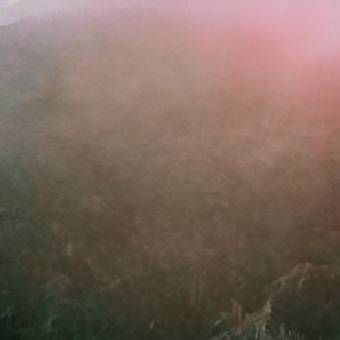
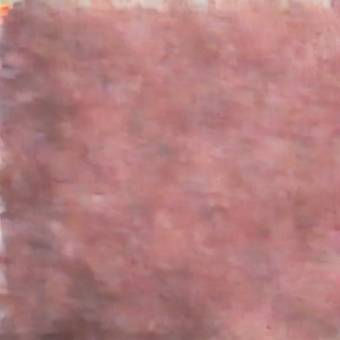
Passes 1 - 20:










Comments